
Apartments in Downtown Phoenix: A Renter's Guide to Neighborhoods, Costs, and Trade-Offs
Downtown Phoenix has changed a lot in the last decade. What used to empty out after 5 p.m. now has an arts district, a university campus, ballgames, and enough restaurants that people actually want to live there. If you're searching for an apartment in the middle of it all, the harder question isn't whether you'll find one. It's whether the walkable-city lifestyle is worth the higher rent and smaller square footage that usually come with it.
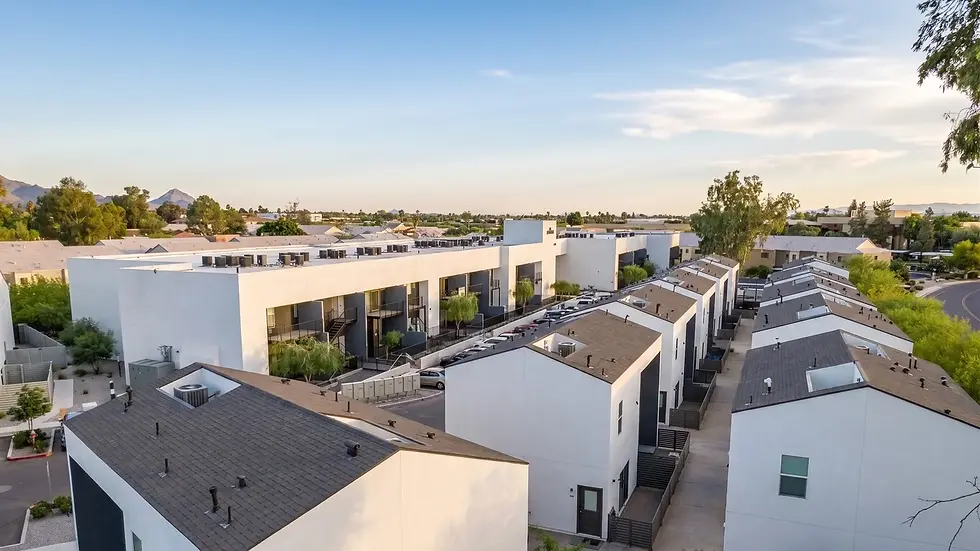
This guide walks through what downtown really offers, the neighborhoods you're choosing among, roughly what it costs, and where a quieter spot north of the core might serve you better for less money.
Quick answer: Apartments in downtown Phoenix put you a short walk from the ASU campus, Roosevelt Row, sports arenas, and the light rail, which is the main reason to live there. Expect to pay more per square foot than the suburbs and to trade space and easy parking for that walkability. One-bedroom rents downtown commonly run higher than the metro average, so it pays to compare the core against nearby North Phoenix before you sign.
Key takeaways
Downtown Phoenix is best if you value walkability, nightlife, and light rail over square footage and cheap parking.
The area splits into a few pockets like Roosevelt Row, the Warehouse District, and the Central Avenue corridor, each with its own feel and price.
Rent downtown usually costs more per square foot, and many buildings add parking and amenity fees on top.
If you want more room and a lower starting rent, North Phoenix communities a short drive north are worth comparing.
What is a downtown Phoenix apartment?
A downtown Phoenix apartment is one inside or right next to the city's central core, roughly the area bounded by the sports arenas, the ASU downtown campus, and the Central Avenue business corridor. Most of the housing here is mid-rise and high-rise buildings rather than garden-style complexes, which is why units tend to be more compact and rents run higher.
The label gets stretched in listings. Some ads say "downtown" for buildings that are really in Midtown up Central Avenue, or in the emerging neighborhoods just outside the core. That distinction matters, because a true downtown address buys you an easy walk to offices, games, and restaurants, while a Midtown or fringe address usually means a lower rent and a short light rail ride or drive to reach the action. When you tour, check the actual cross streets rather than the marketing.
The main downtown neighborhoods, and who each fits
Downtown isn't one place. The pocket you pick shapes your rent, your noise level, and your daily walk.
Roosevelt Row (RoRo): The arts district, full of murals, galleries, coffee shops, and First Friday crowds. Great if you want energy at your doorstep. It can also be loud on weekends, and newer buildings here charge for it.
The Warehouse District: South of the tracks, a mix of adaptive-reuse lofts and newer construction with a grittier, industrial character. Fewer grocery options within a few blocks, so plan around that.
Central Avenue corridor: The office and light rail spine running north from the core into Midtown. This is where you'll find the most high-rise apartment towers and the easiest transit access, at a range of price points.
Copper Square / the arena core: Closest to Chase Field and the Footprint Center. Convenient for sports and events, though game nights bring traffic and street noise.
A big draw across all of these is transit. The Valley Metro light rail runs straight through downtown and up Central, which is what lets some residents get by with one car or none. If that's your plan, prioritize a building within a few blocks of a station.
Where The Landon fits: more room, a short drive north
If your search for downtown is really a search for a nice apartment that doesn't wreck your budget, it's worth looking a short drive north. The Landon sits in North Phoenix at 8125 N 23rd Ave, close enough to reach downtown's jobs and events by car or light rail, but priced and sized like a place you can actually stretch out in.

The trade you're making is simple. You give up the walk-everywhere downtown address, and in return you get loft-style apartments and townhomes with more square footage, gated underground parking, and a starting rent that's often below what a comparable downtown unit runs. Floor plans here include 1 and 2 bedroom loft-style apartments plus 1, 2, and 3 bedroom luxury townhomes, with homes starting at $1,645 a month. You can see current layouts on the floor plans page.
Inside, the homes come with a full-size washer and dryer, high ceilings that run 9 to 11 feet depending on the home, solid wood barn doors, and high-end appliances. The community adds a resident lounge, a pool and sundeck, a 24/7 fitness center, and gated underground parking with more than 20 EV charging spots. Parking alone can be a real cost saver, since many downtown towers charge monthly for a covered space.
Two more things renters ask about. The Landon is a pet-friendly community with a large dog and walking park right next door, so a dog isn't a dealbreaker here. And applications are free with fast approvals, reviewed individually, which the team explains as part of its attainable luxury approach. If you want the numbers for your household, the leasing team at 480-572-0006 will give you a straight answer.
The Landon is only one option here. The rest of this guide goes back to helping you weigh downtown itself.
What downtown apartments really cost
Rent downtown almost always runs higher per square foot than the metro-wide average, and the gap widens for newer high-rise buildings with concierge desks and rooftop pools. A studio or one-bedroom in a modern downtown tower commonly lands above the citywide one-bedroom average, while older converted lofts and Midtown buildings can come in lower.
The sticker rent is only part of it. Budget for the extras that downtown buildings lean on:
Parking fees: Covered or garage parking is frequently an added monthly charge downtown, sometimes per space.
Amenity and tech fees: Pools, lounges, and building wifi can show up as recurring line items.
Utilities and valet trash: Ask what's bundled and what's billed back to you.
Move-in costs: Deposits, admin fees, and any pet fees add up front.
When you compare two apartments, add these together before you decide. A "cheaper" downtown unit with a $150 parking charge and an amenity fee can end up costing more than a roomier place a few miles out. Downtown Phoenix Inc keeps a helpful overview of the district and its neighborhoods and development if you want to understand what's driving the pricing.
Downtown high-rise vs. North Phoenix loft-style: a quick comparison
The clearest way to choose is to put the two lifestyles side by side.
What you're weighing | Downtown high-rise | North Phoenix loft-style (e.g. The Landon) |
|---|---|---|
Typical rent | Higher per square foot | Lower starting rent, from $1,645/mo |
Space | More compact units | Loft apartments and townhomes, more room |
Parking | Often a paid monthly add-on | Gated underground parking included, with EV charging |
Getting around | Walk and light rail; car optional | Car-based, with light rail reachable |
Vibe | Nightlife, events, foot traffic | Quieter, residential, dog park next door |
Best for | Living in the middle of the action | More home for the money, easy parking |
Neither column is "better." It comes down to whether you'd rather walk to a game or park for free and have a spare bedroom. For a deeper look at the tower option, this guide to Arizona high-rise apartments breaks down views, costs, and trade-offs, and if the industrial look is what drew you downtown, the Phoenix lofts guide covers styles and neighborhoods.
What to look for before you sign a downtown lease
A few checks save you from regret after move-in:
Walk the block at night. Downtown is lively, which also means noise. Visit on a weekend evening, ideally on a game or event night.
Confirm the parking situation. Ask the monthly cost, whether a space is guaranteed, and what guest parking looks like.
Test your commute both ways. If you'll use the light rail, time the walk to the nearest station and check the schedule for your hours.
Add up the fees. Get parking, amenity, tech, and trash fees in writing so the real monthly number is clear.
Ask about summer. Downtown's concrete holds heat. Check how the unit's AC and windows handle a July afternoon, and whether the pool is actually usable in peak season.
It also helps to compare the core against the areas just outside it. This North Phoenix renter's guide covers what you get for your money a bit further from the center, which is a useful reality check before you commit to a downtown premium.
Frequently asked questions
How much does an apartment in downtown Phoenix cost?
Expect to pay more than the metro average, especially in newer high-rise buildings. A modern one-bedroom downtown often rents above the citywide one-bedroom figure, while older lofts and Midtown units can come in lower. Always add parking and amenity fees to compare the true monthly cost.
Is downtown Phoenix a good place to live?
It's a strong fit if you value walkability, restaurants, arts, and sports over space and quiet. You'll trade square footage and easy parking for being in the middle of everything. Renters who want more room for less money often prefer neighborhoods a few miles out.
Do you need a car to live in downtown Phoenix?
Not necessarily. The light rail and walkable core let some residents get by with one car or none, as long as you pick a building near a station and close to your daily needs. Outside the immediate core, a car becomes much more practical.
What's the difference between a loft and a high-rise apartment?
A loft usually means an open floor plan with high ceilings and an industrial character, sometimes in a converted building. A high-rise refers to a tall tower with many stacked units and shared amenities. You can find both downtown, and the loft look also shows up in newer communities north of the center.
Is The Landon located downtown?
No. The Landon is in North Phoenix at 8125 N 23rd Ave, a short drive north of the downtown core. It's an option for renters who want more space, included gated parking, and a lower starting rent while staying within reach of downtown's jobs and events.
Are downtown Phoenix apartments pet-friendly?
Many are, but policies vary widely by building, with different breed, weight, and fee rules. Always confirm the specific pet policy before applying. If a dog park matters to you, ask what green space is nearby, since pet areas can be limited in the dense core.
When is the best time to look for a downtown apartment?
Availability tends to loosen in the cooler months from late fall through winter, when fewer people are moving. Summer is peak moving season in Phoenix, so you may see more competition and fewer deals. Starting your search a few weeks before your target move date gives you room to compare.
*Equal Housing Opportunity. The Landon is an equal housing opportunity provider. We do not discriminate on the basis of race, color, national origin, religion, sex, familial status, disability, sexual orientation, gender identity or expression, or source of income, in accordance with the federal Fair Housing Act and the City of Phoenix Human Relations Ordinance. Every applicant is evaluated individually under the same written criteria.*


