How to Choose an Apartment Complex in Phoenix, Arizona: A Renter's Guide
Searching for an apartment complex in Phoenix, Arizona gives you thousands of results and almost no way to tell them apart from a listing photo. A pool looks like a pool. A floor plan looks like a floor plan. The real differences, the ones you live with every day, show up in the details: how the complex is built, where it sits in the Valley, what the monthly cost actually includes, and how the leasing team treats you when you apply.

This guide walks through how to compare Phoenix complexes like someone who has toured a dozen of them. We cover the main types, what different areas feel like, honest cost ranges, the amenities worth paying for, and the questions to ask before you sign.
Quick answer: The best apartment complex in Phoenix, Arizona for you comes down to four things: the build type (garden-style, mid-rise, loft, or townhome), the area and commute, the all-in monthly cost after fees, and the application process. Tour at least three, compare them on those four points, and the right fit gets obvious fast.
Key takeaways
Phoenix complexes fall into a few build types, and each trades space, noise, and price differently.
Location changes your rent and your commute more than any single amenity, so pick the area first.
Compare the all-in monthly cost, not the headline rent, since parking, pet, and utility fees add up.
A short, honest application process is a feature worth weighing alongside the granite and the pool.
What is an apartment complex, and how does it differ from other Phoenix rentals?
An apartment complex is a professionally managed property with multiple rental homes, shared amenities, and a single on-site or company leasing team. That last part is what sets it apart from renting a condo from an individual owner or a house from a small landlord. With a complex you get consistent management, a maintenance line, and standardized lease terms, instead of depending on one person's schedule and mood.
In Phoenix specifically, "complex" covers a wide range. Some are sprawling garden communities from the 1980s. Others are new mid-rise buildings near downtown, or smaller loft and townhome communities that feel more residential. Knowing which kind you are touring matters, because a 300-unit complex and a boutique community offer very different day-to-day living even at a similar rent. Phoenix is a big, spread-out city of roughly 1.6 million people, so the same search term returns wildly different products.
The main types of Phoenix apartment complexes (and who each suits)
Start by identifying the build type, because it drives space, noise, and price more than the finishes do. Here are the four you will run into most across Phoenix, Arizona.
Garden-style complexes are low-rise buildings spread over landscaped grounds, usually two or three stories with surface parking. They tend to be the most affordable and offer more square footage per dollar, though older ones can mean thinner walls and dated kitchens.
Mid-rise and high-rise buildings, common near downtown and the light rail, stack homes with interior hallways and structured parking. You trade yard space for walkability and views, and you usually pay more per square foot.
Loft-style apartments feature open layouts, tall ceilings, and an urban look, often in newer North and Central Phoenix communities. They suit renters who want character and volume over a maze of small rooms.
Townhome-style rentals give you multiple floors and often a private entrance or yard, which works well for households wanting more space or a house-like feel without buying.
If you want to go deeper on any one style, our guides to loft living in Phoenix and renting in North Phoenix break down neighborhoods and trade-offs in more detail.
The Landon: one North Phoenix complex worth touring
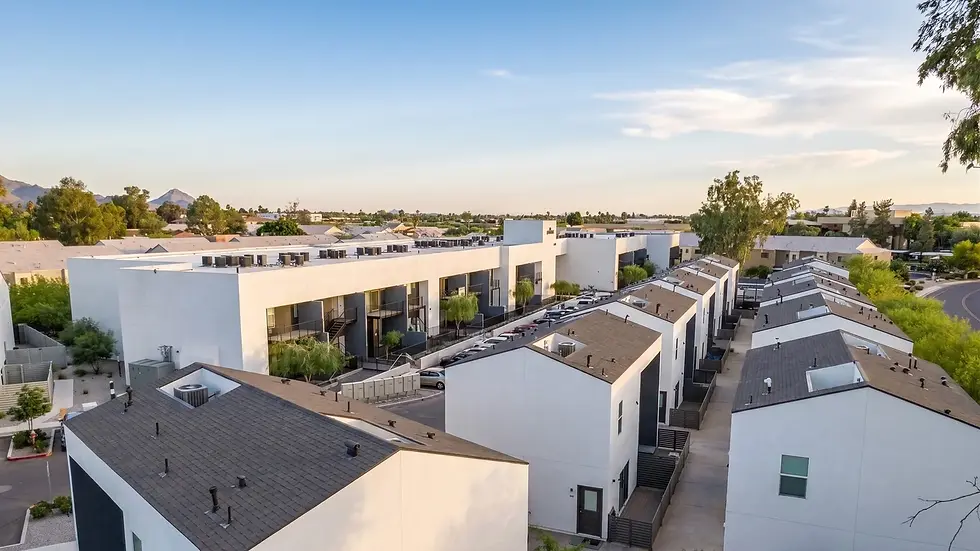
The Landon is a good example of what a modern North Phoenix apartment complex looks like when the goal is attainable luxury rather than a resort fantasy. It sits at 8125 N 23rd Ave, off the I-17 corridor, and mixes loft-style apartments with townhome options, so it fits renters comparing a few of the build types above under one roof.
The floor plans run to 1 and 2 bedroom lofts, plus 1, 2, and 3 bedroom townhomes, with pricing that starts at $1,645 a month. Inside the homes you get a full-size washer and dryer, high-speed wifi, ceilings that run 9 to 11 feet depending on the home, solid wood barn doors, and high-end appliances. Shared amenities include the Landon Lounge, a pool and sundeck, a 24/7 fitness center, and gated underground parking with more than 20 EV charging spots. It is a genuinely pet-friendly community, with a large dog and walking park right next door.
Two things stand out on the leasing side. Applications are free with no application fee, and the team advertises one-minute application approvals, which is a real contrast to communities that take days. The Landon also reviews applicants individually, so a past eviction is welcome to apply and applications are read case by case rather than run through an automatic filter. You can see current sizes and pricing on the floor plans page, read about the attainable luxury approach, or look at the single-family and townhome-style homes if you need more room. Ask the leasing team at 480-572-0006 for current availability and any pet details.
That is one option. The rest of this guide stays about the search itself, because the smart move is to compare The Landon against two or three others on the same points.
How location shapes rent and daily life
Choose the area before the amenity list, because location moves your rent and commute more than a nicer gym ever will. Phoenix is enormous, and a 20-minute difference on the map can mean a couple hundred dollars in rent and a very different morning.
Downtown and Central Phoenix put you near light rail, offices, and nightlife, at higher per-square-foot prices. North Phoenix, along the I-17, tends to offer more space for the money while keeping you close to Grand Canyon University, Deer Valley employers, and quick highway access. The far-north and Deer Valley edges feel more suburban and quieter. When you tour, drive your actual commute at rush hour, not midday, because Phoenix traffic is honest only when it is bad. If you are weighing the north side specifically, our North Phoenix renter's guide maps the sub-areas.
Comparing the complex types at a glance
Here is how the four common build types stack up on the factors renters actually feel. Use it to shortlist, then confirm the specifics on your tours.
Complex type | Typical space | Noise / privacy | Relative cost | Best for |
|---|---|---|---|---|
Garden-style | More sq ft per dollar | Varies; older builds thinner | Lower | Budget and space seekers |
Mid / high-rise | Compact | Interior halls, some shared walls | Higher | Walkability and views |
Loft-style | Open, tall volume | Fewer walls, open sound | Mid to higher | Character and light |
Townhome-style | Multi-floor, largest | Most private, own entry | Mid to higher | Households wanting room |
What an apartment complex really costs in Phoenix
Compare the all-in monthly cost, not the advertised rent, because Phoenix fees stack quickly. The headline number rarely includes everything you will actually pay.
Watch for covered or gated parking fees, pet rent and deposits, trash and pest service, and whether water, sewer, and internet are billed separately. Some complexes fold amenities into rent, while others add them line by line. On move-in, budget for a security deposit and any admin or holding fees on top of first month's rent. A useful habit is to ask each leasing team for a written breakdown of a sample month, then compare those totals side by side. A complex with slightly higher base rent but bundled wifi, laundry, and free parking can beat a "cheaper" one once the add-ons land.
What to look for on a tour
Tour with a checklist so the pool doesn't distract you from the plumbing. The prettiest model unit can hide the things you live with daily.
Water pressure and hot water. Turn on a faucet and shower in the actual unit, not the model.
Cell signal and wifi. Dead zones inside thick or older buildings are common.
Parking reality. See where you would actually park at 8 p.m., not the empty midday lot.
Noise. Listen near the freeway side, shared walls, and any ground-floor breezeway.
Maintenance responsiveness. Ask how long a typical work order takes and whether it is on-site.
Lease flexibility. Check the lease term options, renewal increases, and early-termination terms.
How the application process differs, and why it matters
Treat the application process as a real feature, because a slow or opaque one can cost you the apartment you want. In a competitive Phoenix market, homes move fast, and a complex that takes days to respond may lose your unit to someone quicker.
Ask up front about the application fee, the turnaround time, and the written rental criteria, which you are entitled to see before you apply. Complexes vary widely: some charge non-refundable fees per applicant and take several days, while others are free and near-instant. If your history includes a past eviction, thin credit, or a broken lease, look for communities that state they review applications individually rather than auto-declining, and ask them to explain their process plainly. Under the City of Phoenix source-of-income ordinance, lawful income sources are protected, so a complex should welcome them, not discourage them.
Frequently asked questions
What is the average rent for an apartment complex in Phoenix, Arizona?
Rents vary widely by area and build type, so treat any citywide average as a rough anchor rather than a quote. Central and downtown buildings sit at the higher end per square foot, while garden-style and North Phoenix communities often stretch a budget further. Always compare all-in monthly costs, since fees change the real number.
Which part of Phoenix is best for renters?
It depends on your priorities. Downtown and Central Phoenix win on walkability and transit, while North Phoenix along the I-17 tends to offer more space and easy highway access to major employers. Drive your commute at rush hour before deciding, because map distance and real distance differ in this city.
What is the difference between a garden-style and a loft apartment?
Garden-style complexes are low-rise buildings spread over landscaped grounds, usually offering more square footage for the price. Loft-style apartments have open layouts and tall ceilings for a more urban feel. Garden-style suits space and budget; lofts suit renters who want light, volume, and character.
How much should I budget for move-in costs?
Plan for more than first month's rent. Most Phoenix complexes charge a security deposit, and some add admin, holding, or amenity fees, plus pet deposits if applicable. Ask each leasing office for a written move-in cost sheet so you can compare totals rather than base rents.
Can I rent at a Phoenix complex with a past eviction or imperfect credit?
Often, yes, especially at communities that review applications individually instead of using an automatic cutoff. Look for a complex that shares its written criteria and reads context case by case. The Landon, for example, welcomes applicants with a past eviction and reviews each application on its own merits.
Are Phoenix apartment complexes pet-friendly?
Many are, but the rules vary a lot on breed, weight, pet rent, and deposits, so confirm the specifics before you fall for a place. Some communities also add on-site perks like a dog park. The Landon is pet-friendly with a large dog and walking park next door; ask the leasing team for current pet details.
How fast should the application process take?
It ranges from same-day to several days depending on the complex. Faster is better in a competitive market, since homes get claimed quickly. Ask about the fee, the turnaround, and the criteria up front. Some communities charge no application fee and approve in minutes, which removes both cost and waiting.
What amenities are actually worth paying for?
The ones you will use weekly, not the ones that photograph well. In-unit laundry, reliable parking, and included internet save real money and hassle. A pool or lounge is nice if you use it. Weigh each amenity against its share of the rent, and skip what you would rarely touch.
*Equal Housing Opportunity. The Landon is an equal housing opportunity provider. We do not discriminate on the basis of race, color, national origin, religion, sex, familial status, disability, sexual orientation, gender identity or expression, or source of income, in accordance with the federal Fair Housing Act and the City of Phoenix Human Relations Ordinance. Every applicant is evaluated individually under the same written criteria.*